
Chapter 2 · 2 of 9
Eden.Garden, and an exhibition that had to run for six months
One artwork needed a dead plugin, a dead server, and a dead browser. Solving it once produced a framework that ran eight works for half a year.
In 2025 the exhibition Choose Your Filter! Browser Art since the Beginnings of the World Wide Web opened at ZKM | Center for Art and Media Karlsruhe. It needed twenty-four browser-based artworks spanning 1996–2025 to run daily for more than six months. Eight of them, from the late 1990s and early 2000s, depended on software ecosystems that no longer exist.
One work that needed everything rebuilt
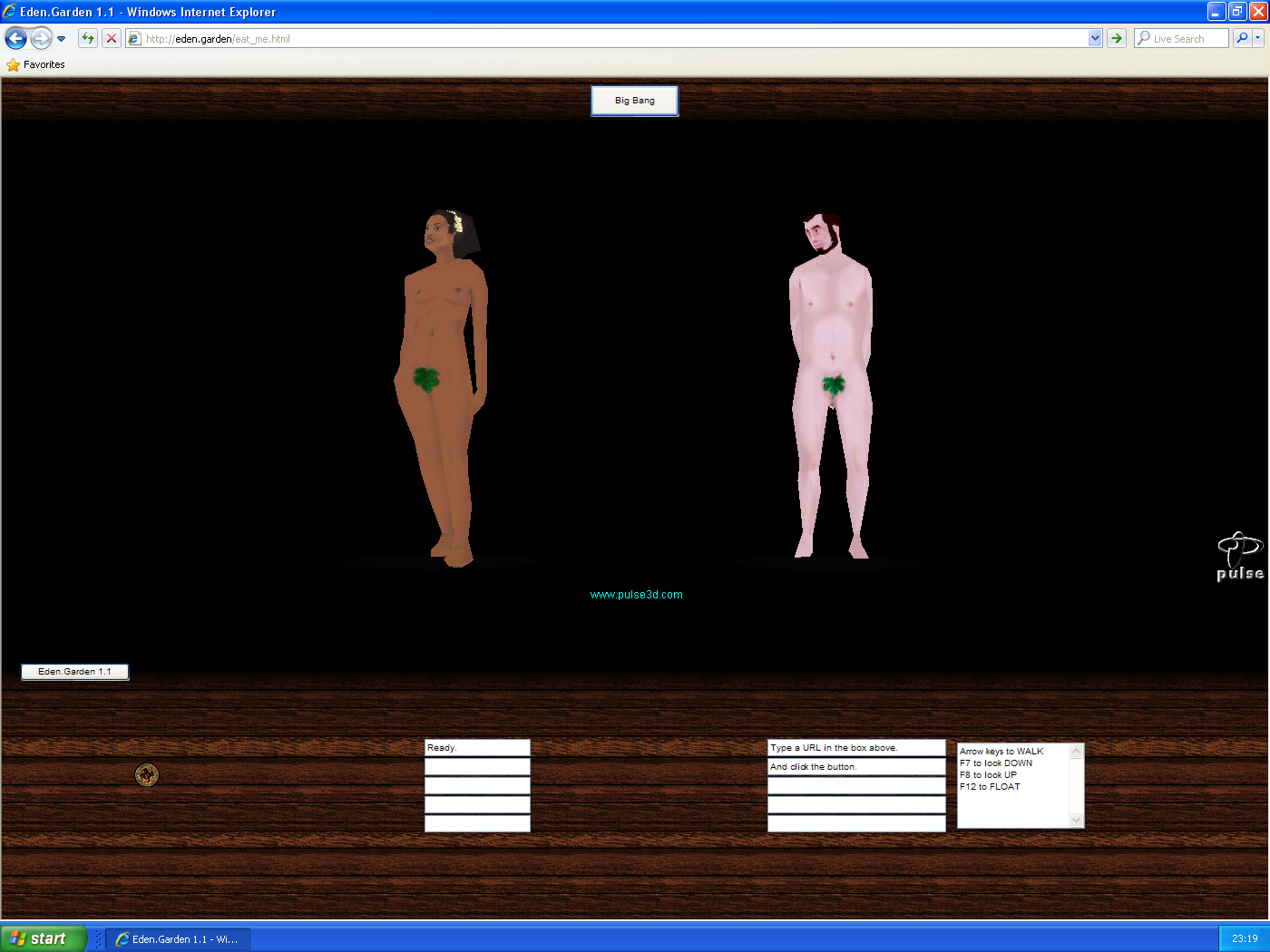
The hardest was Eden.Garden (2001) by Entropy8Zuper! — a browser-based 3D environment that reads HTML pages as input for three-dimensional worlds. It required Pulse3D (a discontinued plugin), Internet Explorer, a server-side Perl script that no longer existed, and websites as they looked around 2001. Reviving it meant finding the abandoned plugin, reverse-engineering the dead server’s behaviour, and mirroring every external dependency locally — until the work believed it was talking to the historical internet while every request was served from controlled, offline storage. The rebuilt environment ran as a virtual machine: a complete computer — the old operating system, browser, and plugin together — running as software inside a modern one.
An installation that had to heal itself
Making the work run once was not enough; it had to survive months of daily public use — crashes, frozen operating systems, visitors leaving it in odd states. The solution was to capture a tested “ready” snapshot of the whole machine — a frozen copy of its exact working state that can be restored at any time — and, whenever anything went wrong, revert to it within seconds. Small scripts inside the machine sent a heartbeat, a regular I’m-alive signal; when it stopped, the host reverted. No diagnosis, no repair — just a return to a known-good state.
This is the system that proves the artwork can run. It is also, deliberately, the wrong tool for understanding a work — which is where the research workbench comes in. First, the idea that makes both possible: a single architectural separation.